
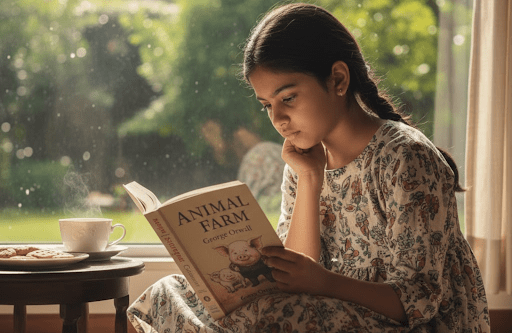
Usually, ‘classic literature’ is just code for dusty old books and long-winded prose that could put a caffeinated owl to sleep. But then you pick up Animal Farm. It’s a total shift—it doesn’t waste time, it doesn’t bore you, and it hits way harder than you’d expect. It’s a complete game-changer—short, sharp, and honestly reads more like a 1940s political thriller than a ‘school book.’ It doesn’t waste your time; it just gets straight to the point
The only catch? The entire cast is made up of pigs, horses, and one incredibly cynical donkey. It sounds ridiculous until you realize they’re more human than most politicians.
Seriously, if you’ve never actually sat down with this—or if you basically just faked your way through the SparkNotes in 10th grade—you really need to give it a proper look. Reading it now, when you actually understand how the world works, is a completely different experience. It’s a total classic for a reason. And a quick tip for the Bengali readers: grab Prabal Basak’s version. It’s easily one of the best Bengali books to read. If you’re looking to get the ‘real’ experience of the book, you honestly shouldn’t settle for any other translation. It’s a total must-read.
The Ultimate Rags to Riches (Then Back to Rags) Story
The animals at Manor Farm have finally had it. They’re sick of Mr. Jones, their lazy, drunk owner, treating them like tools instead of living things. Under the guidance of the pigs—who basically decided they were the smartest ones in the room—they pull off a midnight coup. They chase the humans off the property, paint a fresh set of laws on the barn wall, and for a minute, it actually feels like they’ve won.
For a split second, it’s actually a total utopia. Everyone’s pulling their weight, the harvests are massive, and you can almost feel the hope in the air. It looks like they finally pulled off the impossible. But then, the drama starts. Two pigs, Snowball and Napoleon, start bickering over everything. Eventually, Napoleon uses a pack of scary dogs to chase Snowball away and declares himself the “Big Boss.”
Before you can even process the ‘utopia,’ the pigs start acting like the humans they kicked out—sleeping in beds, drinking, and gaslighting the other animals by changing the laws overnight. The image of them walking on two legs in trousers at the end is just peak nightmare fuel. Honestly, that final moment is probably the most haunting scene in any book, period.
Why are the Themes Still Relatable?
Why are we still talking about a book written in 1945 like it’s the latest book release? It’s because Orwell was a master at calling out human nature.
The gaslighting is real: The character Squealer is essentially the king of spin. Every time the pigs do something shady, he convinces the other animals that they just “remembered it wrong.” It’s a brilliant look at how propaganda works.
The inequality loop: The famous line, “All animals are equal, but some animals are more equal than others,” is basically the ultimate quote for calling out hypocrisy.
Why the Bengali Translation is Awesome
Reading Animal Farm in Bengali (titled Pashu Khamar) is convenient for anyone who isn’t confident in reading in English but still wants a new book to read. Also, Bengali as a language is built for sharp wit and satire, so this translation works just as awesomely as the original language.
Reading Squealer’s gaslighting or Napoleon’s ruthless orders in Bengali just hits differently. The dialogue feels way more biting. Bengal’s revolutionary soul really changes how you read this. The satire in this book honestly stops feeling like some far-off fable and starts feeling like a massive reality check. It’s not really about a farm in England anymore; it’s about the exact same power struggles we’re seeing in our own neighborhoods and on our news feeds every single day.
Ready to Read? Here’s How to Get Your Copy
If you’re ready to see how a group of farm animals can teach us more about politics than a 24-hour news cycle, you can find the Bengali version everywhere:
For the book-smellers: If you’re in Kolkata, head to College Street. You’ll find multiple publishers that have published various versions. Some are literal translations, while others capture the slang and the rhythm of our local dialects.
For the “Add to Cart: addicts: If you want to buy Bengali books online, several websites have made it a breeze. Oxford Bookstore is your best friend here if you want an outstanding translation.
For the scrollers: There are plenty of e-book apps and PDFs around if you want to read on the bus or during a boring lunch break.
This book is a reflection of the worst parts of us. It shows exactly how a dream of equality can spiral into a horror show once power gets involved. It’s satirical, it’s annoying in how accurate it is, and honestly? It’s more human than most novels with actual people in them.
So, stop scrolling and pick up the best Bengali book to read. Whether this is your first time or a revisit to see how much of it’s coming true in the real world, the translation is the way to go!
FAQs
Is the Bengali translation of ‘Animal Farm’ easy to understand for beginners?
Absolutely! Orwell didn’t hide behind big words, and that’s a huge part of why this book works globally. It’s blunt and direct. Most of the Bengali translations I’ve seen do a great job of keeping that ‘everyman’ feel.
Why is the book often called ‘Pashu Khamar’ in Bengali?
Most of the Bengali versions you’ll see are titled Pashu Khamar. It’s a pretty literal translation—pashu for animal and khamar for farm—but there’s something about the way those two words sound together in Bengali that makes the story feel immediately more grounded and local.
Does the Bengali version include the ‘Seven Commandments’?
The Seven Commandments are faithfully translated in the Bengali version.
Visit bloggercreativa for more informative blogs.